


09 Nov Everest Base Camp Trek: The Khumbu Villages Most Trekkers Walk Straight Through
Most people walk the Everest Base Camp trail in twelve days and remember two places: Namche Bazaar and the rocky glacier at the end. The valley in between holds a working community of around 3,000 Sherpa residents, with a school founded in 1961, a hospital at 3,840 m, a climbing training centre in a village of forty houses, and a monastery that has burned down and been rebuilt twice. None of it requires extra days. It requires knowing which afternoon to spend walking somewhere other than the lodge.
Key Takeaways
➡️ The Khumbu is a lived-in valley, not a trekking corridor, with villages that predate tourism by centuries.
➡️ Namche Bazaar’s Saturday market is the valley’s actual trading day and worth timing a rest day around.
➡️ Khumjung, the largest village in the Khumbu, sits one hour off the main trail and sees a fraction of the traffic.
➡️ Deboche, twenty minutes below Tengboche, offers the same monastery access with none of the crowding.
➡️ Phortse holds the Khumbu Climbing Center, which trains Nepali climbers and guides.
➡️ The acclimatisation days are the opportunity. Walking to a village beats sitting in a dining room.
Which Villages Does the Everest Base Camp Trek Pass Through?
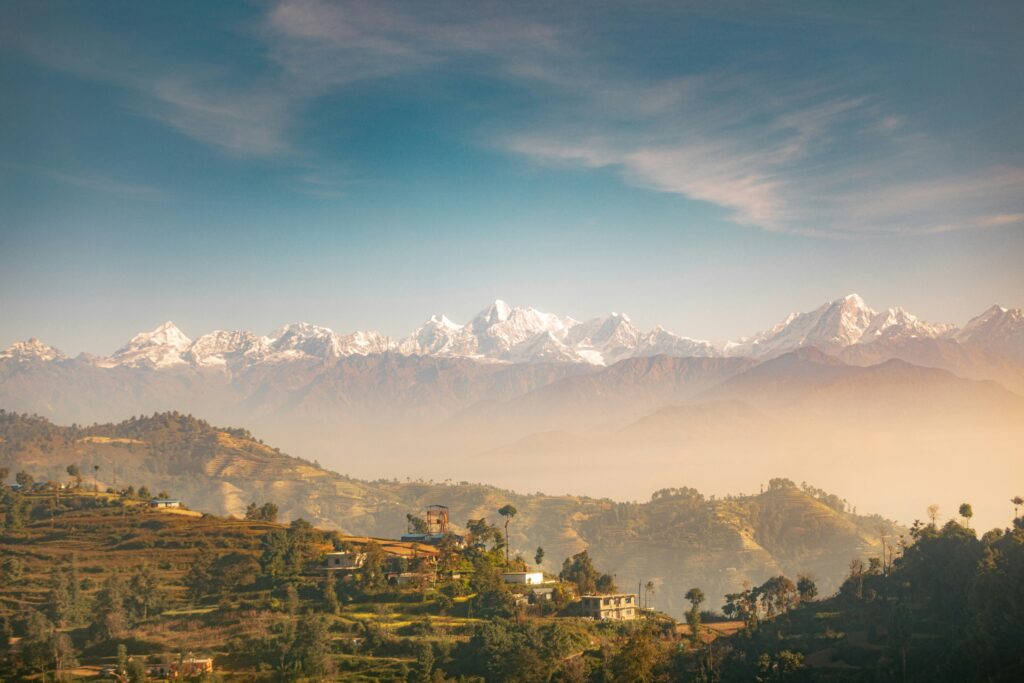
The route climbs through roughly a dozen settlements between Lukla at 2,860 m and Gorak Shep at 5,164 m, and they fall into three categories: real villages with resident families, trail settlements that exist for trekkers, and seasonal herding stations.
Knowing which is which changes what a trekker does with an afternoon. The standard EBC trek stops overnight in eight of them, with two acclimatisation days that are built for altitude rather than for sightseeing, though they work well for both.
| Settlement | Altitude | What it is |
| Lukla | 2,860 m | Airstrip town, gateway to the valley |
| Phakding | 2,610 m | Riverside trail village |
| Monjo | 2,835 m | National park entry checkpoint |
| Namche Bazaar | 3,440 m | The valley’s commercial and administrative centre |
| Khumjung | 3,790 m | Largest Sherpa village in the Khumbu |
| Kunde | 3,840 m | Hospital village above Khumjung |
| Thame | 3,800 m | Old trade-route village, climbing families |
| Tengboche | 3,860 m | Monastery settlement |
| Deboche | 3,820 m | Nunnery, quiet lodges |
| Pangboche | 3,985 m | Oldest monastery in the region |
| Phortse | 3,810 m | Farming village, climbing school |
| Dingboche | 4,410 m | Walled potato fields, summer settlement |
| Pheriche | 4,371 m | Medical post |
| Lobuche and Gorak Shep | 4,940 m, 5,164 m | Lodge clusters, no permanent residents |
Lobuche and Gorak Shep are worth understanding as what they are. Neither is a village. They exist because trekkers need somewhere to sleep at that altitude, and nobody lives in either year-round.
Why is Namche Bazaar More Than an Acclimatisation Stop?
Namche is the Khumbu’s market town, and it has been a trading centre long before trekkers arrived, sitting on the route from Tibet over the Nangpa La pass. The bakeries and gear shops are recent. The Saturday market is not.
The haat bazaar runs on Saturday mornings, when traders come up from the lower valleys with vegetables, rice and household goods, and Sherpa families from surrounding villages come down to buy. Scheduling the acclimatisation day for a Saturday turns a rest day into the most interesting morning of the trek.
Two other things in Namche repay an hour. The Sherpa Culture Museum, above the town on the Everest View path, covers the valley’s settlement history and the Nangpa La trade. And the two ATMs are the last ones on the route, which matters because nothing above Namche takes cards.
| Namche practicalities | Detail |
| Market day | Saturday morning |
| Last ATMs on the route | Two, frequently empty by mid-week in October |
| Laundry service | NPR 200 to 400 per kg, last reliable point |
| Bakeries | Several, with real coffee |
| Lodge rate | NPR 800 to 1,500, more for heated rooms |
What Makes Khumjung Worth the Detour?
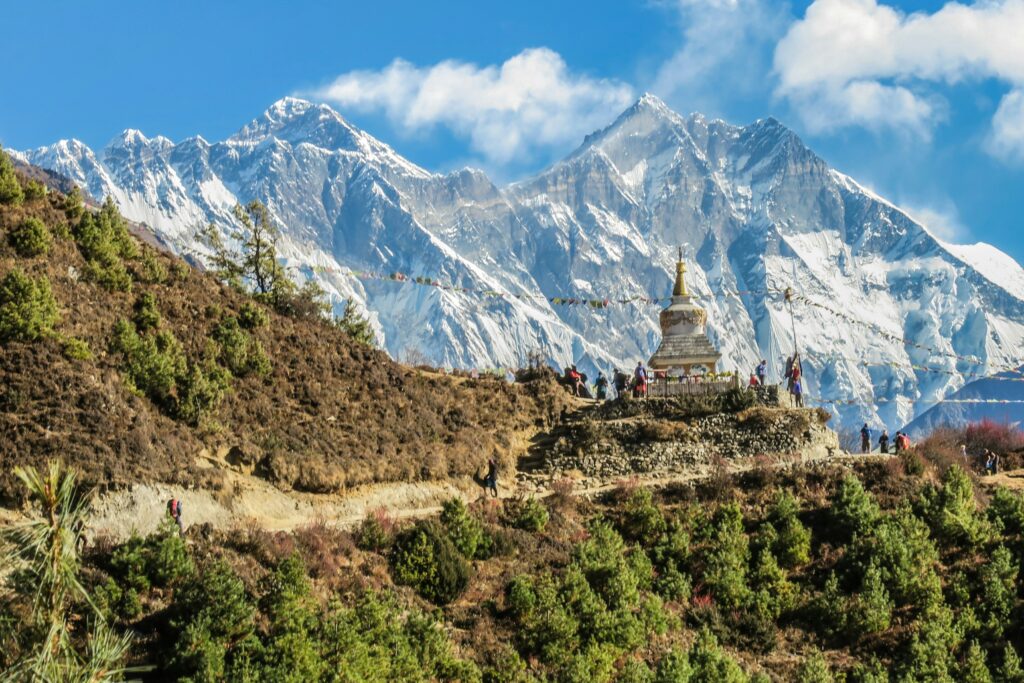
Khumjung is the largest village in the Khumbu, around an hour off the main trail from Namche, and it carries the clearest record of how the valley changed in the last sixty years. The main trail bypasses it entirely, which is why most trekkers never see it.
Khumjung School opened in 1961, built through the Himalayan Trust that Edmund Hillary founded after the 1953 Everest ascent. It was the first school in the valley, and the network it started now covers much of the Khumbu.
The village monastery holds the Khumbu’s most argued-over object: a conical scalp said to be a yeti’s, kept in a glass case. Scientific examination has suggested it is made from the hide of a Himalayan goat-antelope. The monks will show it for a donation of NPR 200 to 500, and the story is better than the verdict.
Twenty minutes above Khumjung sits Kunde and its hospital, opened in 1966 through the same trust. It serves the valley’s residents year-round, which is a different proposition from the seasonal trekker clinics higher up.
The Khumjung and Kunde loop fits inside a Namche acclimatisation day. It climbs to around 3,840 m and returns to sleep at 3,440 m, which is what an acclimatisation day is supposed to do.
Where Do the Khumbu's Climbing Families Come From?
Thame and Phortse, two villages that between them account for a remarkable share of the valley’s high-altitude climbers. Neither is on the Base Camp trail.
Thame sits west of Namche on the old Nangpa La trade route to Tibet, at 3,800 m, and is the home village of several of the most accomplished Everest climbers in the sport’s history, including men holding records for the highest number of summits. Tenzing Norgay spent much of his childhood there.
A glacial lake outburst flood struck Thame in August 2024, damaging homes, the school and parts of the village. Rebuilding has been underway since, and anyone planning to walk there should ask an operator about current conditions and whether visiting is welcome at the time of travel.
Phortse, at 3,810 m, sits across the valley from Tengboche on a shelf of terraced fields. It holds the Khumbu Climbing Center, which runs technical training for Nepali climbers and guides, raising safety standards for the people who work on the mountains rather than for the clients who hire them.
Phortse can be reached as a side trip from Namche, or as an alternative route between Namche and Dingboche that rejoins the main trail higher up. The second option adds no days and takes a trekker along a trail with almost nobody on it.
Should You Stay at Tengboche or Deboche?
Deboche, for a better night with the same monastery access. Tengboche has the Khumbu’s principal monastery and the view of Ama Dablam behind it, and it also has the crowding and the cold that come with sitting on an exposed ridge at 3,860 m.
Deboche is twenty minutes further down the trail at 3,820 m, sheltered in rhododendron forest, with a nunnery and a handful of quieter lodges. Walking back up to Tengboche for the 3 pm prayers takes half an hour and is worth doing.
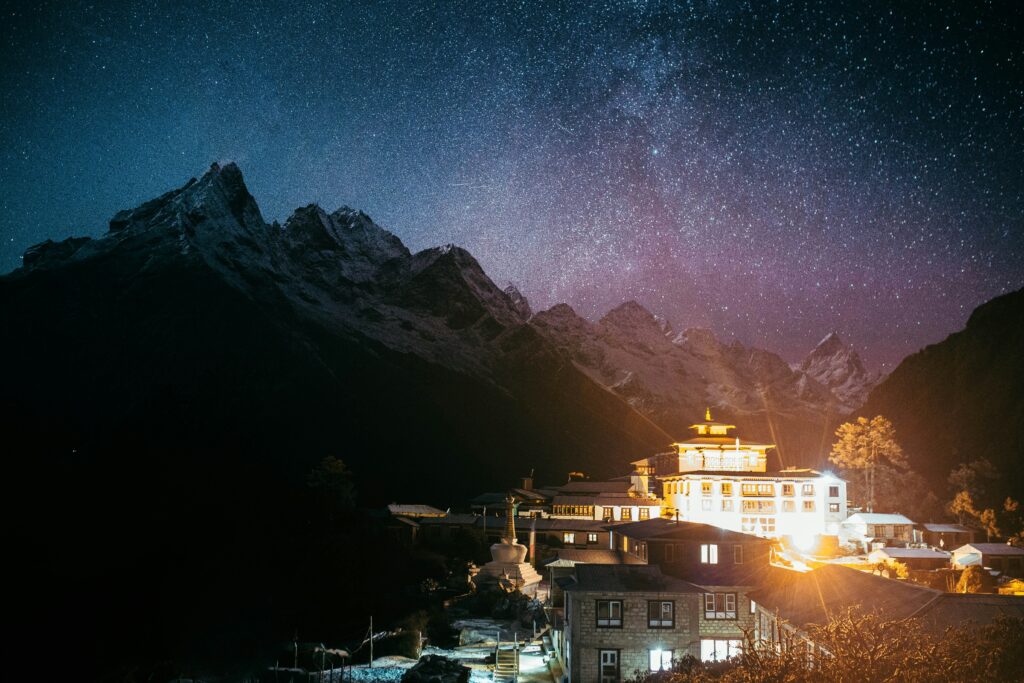
Tengboche monastery itself has an unusual history. Founded in 1916, it was destroyed by the 1934 earthquake, rebuilt, burned down in 1989 after an electrical fire, and rebuilt again with international support. Visitors may sit at the back during the 6 am or 3 pm prayers.
The Mani Rimdu festival runs for three days at Tengboche in October or November, following the Tibetan lunar calendar, with masked dances and a sand mandala built and then deliberately destroyed. Dates are confirmed a few months ahead, and timing a trek around it is worth the effort.
What Are Dingboche and Pheriche Actually For?
Dingboche is a summer settlement turned trekking stop, and Pheriche is where the valley’s emergency medicine happens. Both sit above the tree line at around 4,400 m, and the difference between them is worth understanding before booking.
Dingboche’s stone walls are the detail most trekkers photograph without asking about. They are field boundaries, built to shelter potato and barley plots from wind, and the village was historically occupied in summer by families who herded and farmed there before descending for winter.
Pheriche holds the Himalayan Rescue Association post, staffed by volunteer physicians during the spring and autumn seasons. It runs a free altitude talk most afternoons at around 3 pm, which is the single most useful hour available anywhere on the trek.
| Village | Altitude | Why it matters |
| Dingboche | 4,410 m | Acclimatisation stop, walled fields, Nangkartshang ridge walk |
| Pheriche | 4,371 m | Seasonal medical post and altitude education |
Most itineraries sleep at Dingboche on the way up and Pheriche on the way down, which gives a trekker both.
How Does Khumbu Village Life Compare With Other Trekking Regions?
The Khumbu is Sherpa and Tibetan Buddhist from Lukla upward, which gives it cultural depth in a single region. Other Nepali routes cross several communities in one walk, which trades depth for range.
The Annapurna Circuit trek climbs out of Hindu-majority hill farmland through Gurung villages, then Manang’s Tibetan-influenced settlements, and over the pass into the Thakali country of Mustang, where the architecture, the language and the food change every few days.
| Region | Communities | Village character |
| Everest (Khumbu) | Sherpa, Nyingma Buddhist | Monasteries, schools, climbing heritage, one culture in depth |
| Manaslu | Nubri and Tsum, Tibetan Buddhist | Remote gompas, villages a day’s walk from Tibet |
| Annapurna | Gurung, Manangi, Thakali | Cultural change every few days, apple orchards, desert north |
Neither is better. The Khumbu suits a trekker who wants to understand one place properly, and the Annapurna routes suit one who wants to watch a country change on foot.
How Do You Build Village Time Into a Standard Itinerary?
By using the two acclimatisation days as walking days rather than rest days, and by choosing where to sleep rather than accepting the default. No extra days are needed.
Four substitutions that cost nothing:
1. Namche acclimatisation day: walk the Khumjung and Kunde loop instead of the Everest View Hotel path. Same altitude gain, a village at the end of it.
2. Namche to Tengboche: take the Phortse variant where the schedule allows, which rejoins the main trail and sees a fraction of the traffic.
3. Tengboche night: sleep at Deboche instead, and walk up for the afternoon prayers.
4. Pheriche on the descent: attend the 3 pm altitude talk rather than reaching the lodge and stopping.
A fifth, if a spare day exists at the start: ask about the Thame walk from Namche, and about whether the village is receiving visitors at the time of travel.
One thing worth asking an operator directly. Guides from the valley usually have family in one or more of these villages, and a guide who grew up in Phortse or Thame will take a group somewhere a printed itinerary never mentions. That question at the booking stage is worth more than any amount of reading.
Frequently Asked Questions
How many villages does the Everest Base Camp trek pass through?
Around a dozen settlements between Lukla and Gorak Shep, of which eight are standard overnight stops. Several of the most interesting sit an hour off the main trail.
Is Namche Bazaar worth two nights?
Yes, and the itinerary builds in two anyway for acclimatisation. Timing the rest day for a Saturday adds the weekly market.
Can Khumjung be visited without adding days?
Yes. The Khumjung and Kunde loop fits inside the Namche acclimatisation day and provides the altitude gain that day is designed for.
What is the yeti scalp at Khumjung monastery?
A conical relic kept in a glass case, which examination has suggested is made from the hide of a Himalayan goat-antelope. The monks show it for a small donation.
Is Tengboche or Deboche the better place to sleep?
Deboche, at 3,820 m, is sheltered, quieter, and twenty minutes below the monastery. Walking back up for the 3 pm prayers takes half an hour.
Do people live at Gorak Shep?
No. Gorak Shep and Lobuche are lodge clusters that exist for trekkers, with no permanent residents.
When is the Mani Rimdu festival at Tengboche?
October or November, over three days, following the Tibetan lunar calendar. Dates are confirmed a few months ahead.
How can trekkers support these villages directly?
Eat and sleep at the same lodge, since room rates assume it, and food is where families earn and give to village schools rather than to individuals on the trail.

No Comments